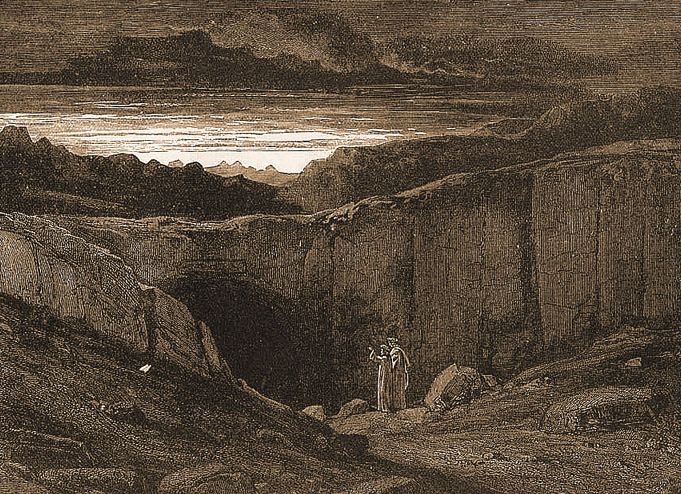
Although the first part of the Divine Comedy, Inferno, begins at canto one, the journey to Hell itself starts in earnest in the third canto with Dante and Virgil arriving at Hell’s gate. Arguably the most famous lines from the poem is the inscription on the gate:
I AM THE WAY INTO THE DOLEFUL CITY,
I AM THE WAY INTO ETERNAL GRIEF,
I AM THE WAY TO A FORSAKEN RACE
JUSTICE IT WAS THAT MOVED MY GREAT CREATOR;
DIVINE OMNIPOTENCE CREATED ME,
AND HIGHEST WISDOM JOINED WITH PRIMAL LOVE.
BEFORE ME NOTHING BUT ETERNAL THINGS
WERE MADE, AND I SHALL LAST ETERNALLY.
ABANDON EVERY HOPE, ALL YOU WHO ENTER.
In addition to being a chilling passage, Dante the poet gives us his first hint of the inversion of all Christian values in Hell. It’s not an accident that the first three lines of the inscription bear a striking resemblance to Jesus’ words in the Gospel of John (”I am the Way, and the Truth, and the light”). We will see throughout Inferno how Dante has mocked and twisted God’s creation and virtues in Satan’s world.
Upon reading the inscription, Dante (the character) remarks how cruel he feels these words are. This is another preview of what we’ll see in later cantos, the moral growth of Dante. He will eventually learn that those souls in Hell are there because they want to be, it is Divine Justice, not Divine cruelty. Virgil’s role is that of a moral guide and teacher, not just a tourguide, and a lot of his time will be spent educating Dante.
They now pass through the gate and begin to hear shrieks, cries, and sighs. continue the journey… or …go back…
7 Responses
Murray
02|Sep|2010 1I was resigned to believe that I was the last of mortals still studying the classic literature of by-gone eras.
Jordan
13|Apr|2011 2With the existence of The Divine Comedy, I think there will be more people going to read the poem. By the way, the term Comedy does not mean a funny story but a tale with a happy ending. Bravo Danteā¦
Jeff Thompson on free shed plans
15|Apr|2011 3Dante’s Inferno can be a highly symbolic work working with themes of sin, salvation, and redemption. Its view of Hell draws on Catholic Christian doctrine before the late Old and Early Renaissance, any time when Dante wrote his great work.
Within an article by Serge Basset printed in Le Martin in 1890, Rodin Said: “For an entire year I lived with Dante, with him alone, drawing the circles of his inferno. At the conclusion of the year, I realized that while my drawing rendered my vision of Dante, that they become too remote from reality. Thus started yet again, working from nature, with my models.”
Emily
09|May|2011 4I have learned about Dante but it is hard to get the feeling inside his divine comedy. I was not surprised when only few people learn about this book. This is one of Canon literature till this day.
John
22|Aug|2011 5“Dante the poet gives us his first hint of the inversion of all Christian values in Hell.” - I am still trying to figure it out
Teresa
07|Dec|2011 6I “read” this classic as an audio book and I wanted a better understanding of many of the passages. This is a great resourse and just lucked onto the site.
Dan Brusca
27|Jan|2012 7What a haunting inscription, especially the final “ABANDON EVERY HOPE, ALL YOU WHO ENTER.” Enough to send chills down the spine…
Leave a reply
Additional Dante Articles on Facebook!
Most Popular
Categories
A design creation of Design Disease
Copyright © 2007 - Dante’s Inferno - is proudly powered by WordPress
InSense 1.0 Theme by Design Disease brought to you by HostGator Web Hosting.