Dante Explorer

A journey through the afterlife of Inferno, Purgatory, and Paradise

Archive for June, 2008

Reading Dante’s Divine Comedy for the first time can be confusing. The poem includes references to classical literature, medieval theology, Italian politics, and literary issues that scholars are still debating. In addition, there are many translations (some good, some not so good) to choose from. This article will help you get started on this amazing and very rewarding journey.


The Story

The Divine Comedy is Dante’s story of his journey through the afterlife of Hell, Purgatory, and Heaven. It begins with Dante waking from sleep, lost in a dark wood. After a few attempts at escape, he encounters the poet Virgil, who tells Dante the only way out is down through the center of the earth through Hell.

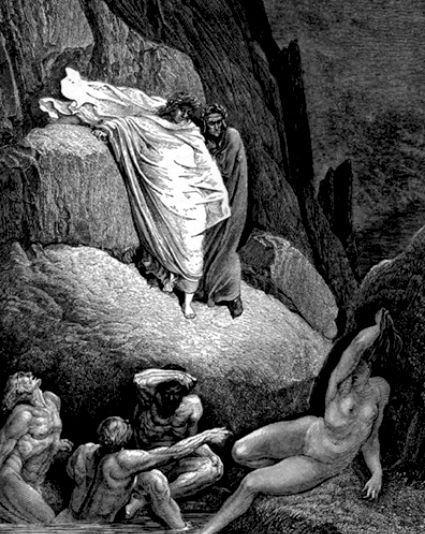
Virgil leads Dante through Hell, encountering terrifying scenes of punishment as well as meeting up with various inhabitants from Florence, the Bible, and classical literature. The journey through Hell ends with Dante and Virgil meeting Satan and escaping out of the other side of the earth.

The two travelers then encounter the Mountain of Purgatory, where they join all those destined for Heaven in the journey of purification. Just as in Hell (Inferno), Dante meets up with real and fictional characters, each with a story to tell.

Near the top of the Mountain of Purgatory, Dante changes guides and begins his journey through Paradise (Heaven) culminating in a vision of God.

Dante the Man

Dante Alighieri was born in Florence around 1265. He had a good education and was influenced in large measure by the writings of the poet Virgil, specifically his work, The Aeneid. Themes and characters from The Aeneid appear constantly in the Divine Comedy. Florentine politics also played a major role in the story and characters of the Divine Comedy. That period of history was dominated by power struggles within the various city states in Italy. The two groups competing for power in Florence were the Guelphs (artisans, new money, lesser nobility) and the Ghibelline’s (old money, aristocracy). These divisions, typically followed family lineage, with Dante being a member of the Guelph party.

Through much of Dante’s life, the Guelphs were in power, in fact Dante held a government position for a time. However, a bitter split developed within the Guelph party creating two factions, the Whites (to which Dante belonged), and the Blacks. Pope Boniface VIII eventually sided with the Black Guelphs, and consequently Dante was exiled from Florence. It’s no accident that Boniface ends up in Hell in Dante’s poem.

The Divine Comedy was written when Dante was exiled from his beloved city (to which he never returned). Exile and redemption is a theme which runs throughout this work. In addition, many of Dante’s political friends and enemies appear in the different sections of the afterlife. The character of Beatrice in the poem is believed to be the real woman, Beatrice Portinari, whom Dante knew and possibly fell in love with (however she was married) in Florence. Dante went on to write his first major work, Vita Nuova, as a love poem to her. Beatrice died at a young age, and although Dante did get married, he never seemed to recover from her death. Beatrice’s role in the Divine Comedy has come to represent all that is good, as well as the theological personification of grace.

The Divine Comedy can be read at so many levels; poetry, narrative, political, theological. Dante scholars have written volumes on this amazing work, and continue to do so to this day.

The Poetry

Dante’s Divine Comedy is not only a classic story, but also a masterpiece of poetry. It is the first major poem written in the everyday spoken language of the writer (Italian). Previously, classical poetry was written in Latin. The number 3 plays an important part in the divisions of this book, representing the 3 Persons of the Trinity.

The work is divided into 3 books, each book is divided into chapters, or Cantos.

The books are:

1. Inferno (Hell) containing 33 cantos plus one introductory Canto.

2. Purgatorio (Purgatory) containing 33 Cantos.

3. Paradiso (Paradise) containing 33 Cantos.

The cantos are divided into 3 line units called Tercets.

Dante also devised a rhyme scheme which he called terza rima . The rhyme scheme is:

aba, bcb, cdc, ded, etc.

When you hear this read out loud, this scheme pushes the poem forward, keeping the journey moving.

Here is the beginning of the first canto, showing the rhyme:

Nel mezzo del cammin di nostra vita (a)

mi ritrovai per una selva oscura. (b)

ché la diritta via era smarrita. (a)


Ahi quanto a dir qual era è cosa dura (b)

esta selva selvaggia e aspra e forte (c)

che nel pensier rinova la paura! (b)


Tant’è amara che poco è più morte; (c)

ma per trattar del ben ch’i’ vi trovai, (d)

dirò de l’altre cose ch’i’ v’ho scorte. (c)


Some editions have side by side English and Italian text, which can greatly enhance the experience of reading the Divine Comedy.


The Divine Comedy is work of literature that is timeless and grows as we grow.


The Moneylenders

Out of the pit where Dante’s belt was thrown rises a terrifying monster with the head of a man, the body of a serpent, and the tail of a scorpion. This is Geryon, who “swims” through the murky air of the abyss, undulating his body like an eel while stroking the air with his claws. Geryon represents the sin of fraud, with a trusting face and a deadly tail. Incredibly, he will be giving Dante and Virgil a “ride” down to the pit.

While Virgil speaks to Geryon, Dante talks to another group of souls nearby squatting on the sand, the Usurers, or moneylenders. Their faces are unrecognizable from the burns and ash, and are identified only by the insignias of the moneybags around their necks. Dante then joins Virgil and Geryon to continue in their journey of terror. …continue…or…go back…

The Teacher from Hell

As the group of the souls of the sodomites run by, one of them approaches Dante and Virgil. It is Dante’s old teacher, Brunetto Latini. The two have a brief discussion and Dante learns that these souls must always keep moving, or will be forced to lie on the ground for 100 years unable to brush off the rain of fire. Brunetto points out some other residents of Hell that Dante knows (some political friends as well as enemies), and then runs off. Dante expresses grief and compassion for the fate of his old teacher, unlike some other residents of Hell.

Three more souls approach, and in order to keep moving while speaking with Dante, they form a circle around him, constantly walking and talking. Dante the poet compares this to a strange dance, like wrestlers circling each other before a match. The eternal aimless wandering of the souls of the sodomites, is a similar theme to that of the souls in the circle of the lustful who are constantly buffeted by the wind.

After this group races off, Dante and Virgil approach a deafening waterfall. Virgil then takes the cord that Dante had tied around his waste and throws it into the abyss where the waterfall empties. Dante is shocked by what he sees next. …continue…or …go back…

Add to Google