Dante Explorer

A journey through the afterlife of Inferno, Purgatory, and Paradise

Archive for June, 2008

A Chat with a Pope

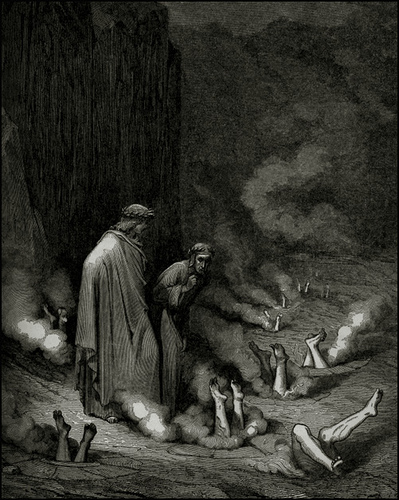
Dante and Virgil enter a rocky area filled with holes. Sticking out of these holes are twitching legs and feet with flames coming off them. This is the circle of the Simonists, those who sold church offices. Dante has a bizarre conversation with one of it’s inhabitants (who is stuffed into a hole).

The soul happens to be the corrupt Pope Nicholas III, who mistakes Dante for the next sinner to arrive, Pope Boniface VIII, Dante’s political enemy. As each new sinner arrives, they are stuffed into the hole on top of the previous sinner, pushing them farther down.

Dante reserves some of his harshest criticisms for these sinners who have led their flock astray. Just as in life, these souls have turned the church upside down, so they are punished in the same way. Instead of the Holy Spirit descending on the heads of the Apostles, the flames of punishment forever burn the sinners feet. As Dante and Virgil move on , things just keep getting stranger. …continue…or…go back

Journey to the Pit of Hell

Dante leaves the usurers and rejoins Virgil where he is instructed to mount the back of the monster Geryon. Dante and Virgil take a terrifying, slow, spiraling trip down to the next level of Hell. This level has ten ravines like concentric circles attached by bridges, similar to spokes on a wheel. After getting off the monster, Dante and Virgil encounter two lines of souls walking in opposite directions.

One group is the panderers (pimps), the other is the seducers. Each line of these naked souls are constantly getting painfully whipped by devils as they eternally walk. Dante recognizes one of the panderers as the head of a political party in Italy who pimped his own sister for political gain.


Moving on, Dante then begins to smell a horrible stench as they approach the circle of the flatterers. The flatterers grovel eternally in excrement, living in the substance which previously came out of their mouths (Dante did have a sense of humor). Included in this group is the literary character of Thais, the whore, as well as another political figure from Florence. Dante and Virgil then move on to the next circle where they see one of the most interesting landscapes in the Inferno. …continue…or…go back

Which Translation Should I Read?

Choosing which translation of Dante’s Divine Comedy to read is a very subjective and personal decision. Any translation involves balancing the meaning, feel, and artistry of the work, normally at the expense of at least one of these qualities. A major consideration is the topic of rhyme. The Divine Comedy has a complex rhyme scheme that suits itself well to the rhyme-rich language of Italian (where, unlike English, many words end in vowels). Translations that attempt to maintain any type of rhyme scheme often sound forced and usually compromise the meaning of the text.

At the other end of the spectrum are straight prose (spoken word) translations. Prose translations are great for communicating the story and it’s nuances, however any poetical structure is lost. A third choice is a translation written in blank verse (iambic pentameter). This format allows freedom to communicate the work without rhyme, yet maintains a metrical structure. In addition, it’s well suited for English (Shakespeare wrote much of his work in blank verse).

So, which translation should you read? I have no vested interest in selling a particular author’s work, my recommendations are just my personal opinion. My favorite version is by Mark Musa (written in blank verse). I also enjoy Anthony Esolen’s translation (blank verse with some rhyme).  They also both have good notes (a necessity). Ultimately, it’s great to read a few and decide which version you like best, each has strengths and weaknesses.


Google Reader or Homepage
Subscribe with Bloglines

Categories

-->
-->

Please Visit - The Dante Explorer Store