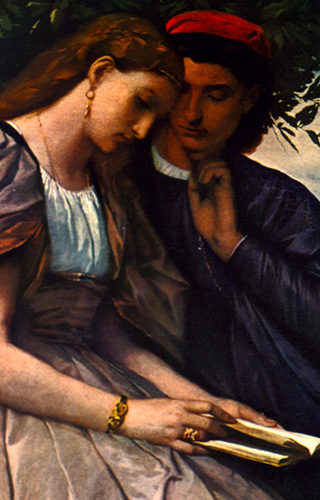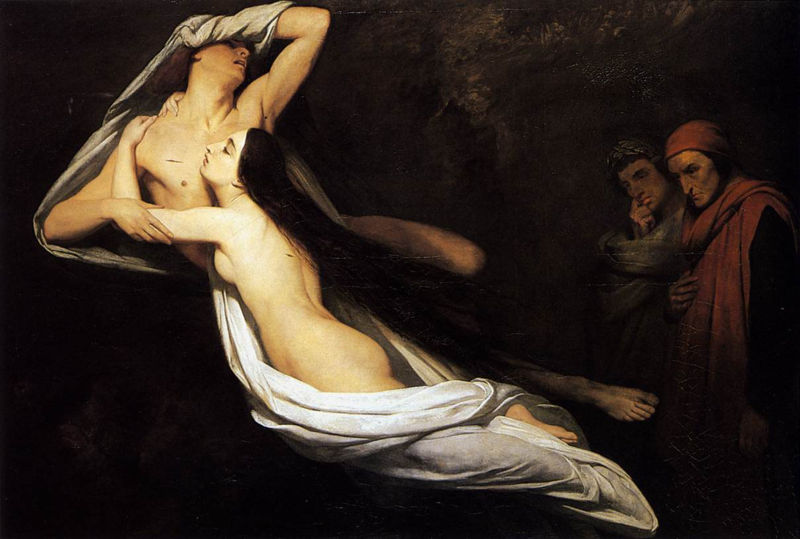
Dante spends some time talking to one couple swirling in the wind, locked together for eternity. They are Paolo and Francesca, lovers, famous even in Dante’s time. Unfortunately, Paolo was not married to Francesca, he was her brother in law and was murdered by her husband, caught in the act.
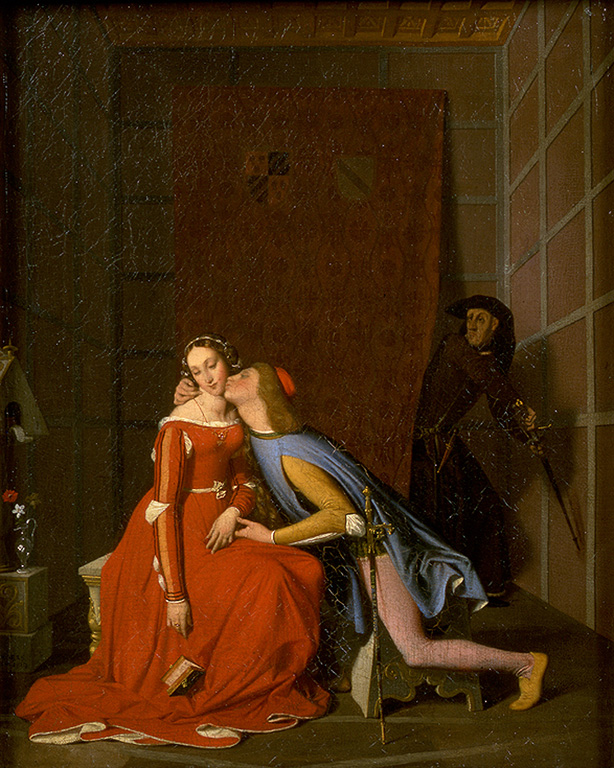
As with all sinners in Hell, they are unrepentant, never taking responsibility for their transgressions. In her case, Francesca blames her act on a book they were reading together, the story of Lancelot and Guinevere. This moment is also strangely comical, since Francesca believes Dante is in Hell just to pay her a social call.
When Francesca tells Dante the story of her death, she spins it to try and evoke pity from Dante. Dante is taken in by her false charm and misplaced compassion. The canto ends with Dante weeping and fainting, overcome by sadness. This points out another aspect of the Divine Comedy, Dante’s moral growth. As he progresses through Hell, Dante learns to discern the truth from the lies that the damned actually tell him. continue the journey… or …go back…
As Dante and Virgil approach the second circle of Hell, they are greeted by the man/serpent Minos. Minos acts as sort of a doorman, judge, and travel agent for the souls of the damned. The souls approach him, and in a mockery of confession tell him their sins. Minos then passes judgement on them, displaying the circle of Hell they are condemned to by how many times he wraps his tail around himself.
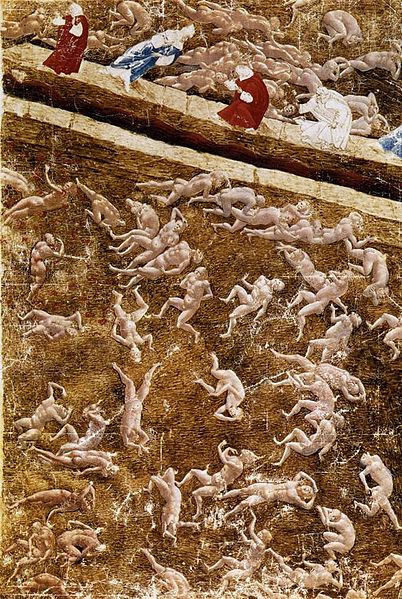
Dante and Virgil are allowed to pass into the second circle of Hell, the circle of the lustful. Here the souls of the lustful are caught up (often together) in an eternal, violent, dark storm, bumping up and down as birds in a tornado. Once again Dante’s punishment mirrors the crime, these are souls who were out of control with their carnal desires in their earthly life. For eternity they will be spending time with each other, out of control in Hell.
Like all souls in Hell, they have submitted reason to their desires, and most importantly, are unrepentant. Dante sees many souls he recognizes including Cleopatra, Achilles, and Helen of Troy. Dante and Virgil then spend time speaking to one adulterous couple who Dante is familiar with. The conversation is with two of the most famous characters in the Divine Comedy, Paolo and Francesca. continue the journey… or …go back…
Dante awakens to find himself in on the other side of the river Acheron, where Virgil leads him down into the first circle of Hell. Unlike when he first entered, Dante doesn’t hear screams of terror, instead he just hears sighs of sadness and hopelessness. This is Limbo, where the souls of the virtuous pagans reside. These include Homer, Socrates, Plato, and Dante’s guide Virgil. These souls had no knowledge of Christ (being born before Him), and so died unbaptized.
In Medieval theology, these souls, though good, could not go to heaven. There only “punishment” was to live in desire of seeing God without hope. Medieval tradition also holds that when Christ was resurrected, he went down to this part of Hell and took some of the inhabitants (including Noah, Moses, and Abraham) to Heaven. Dante ends up talking with great philosophers, scientist, artists, and leaders at the base of a great castle. This represents the highest that humans can achieve without God. Interestingly, the name Christ is never spoken anywhere in Hell.
After this fairly pleasant experience, Virgil leads Dante down lower into Hell, where things quickly get much worse. continue the journey… or …go back…